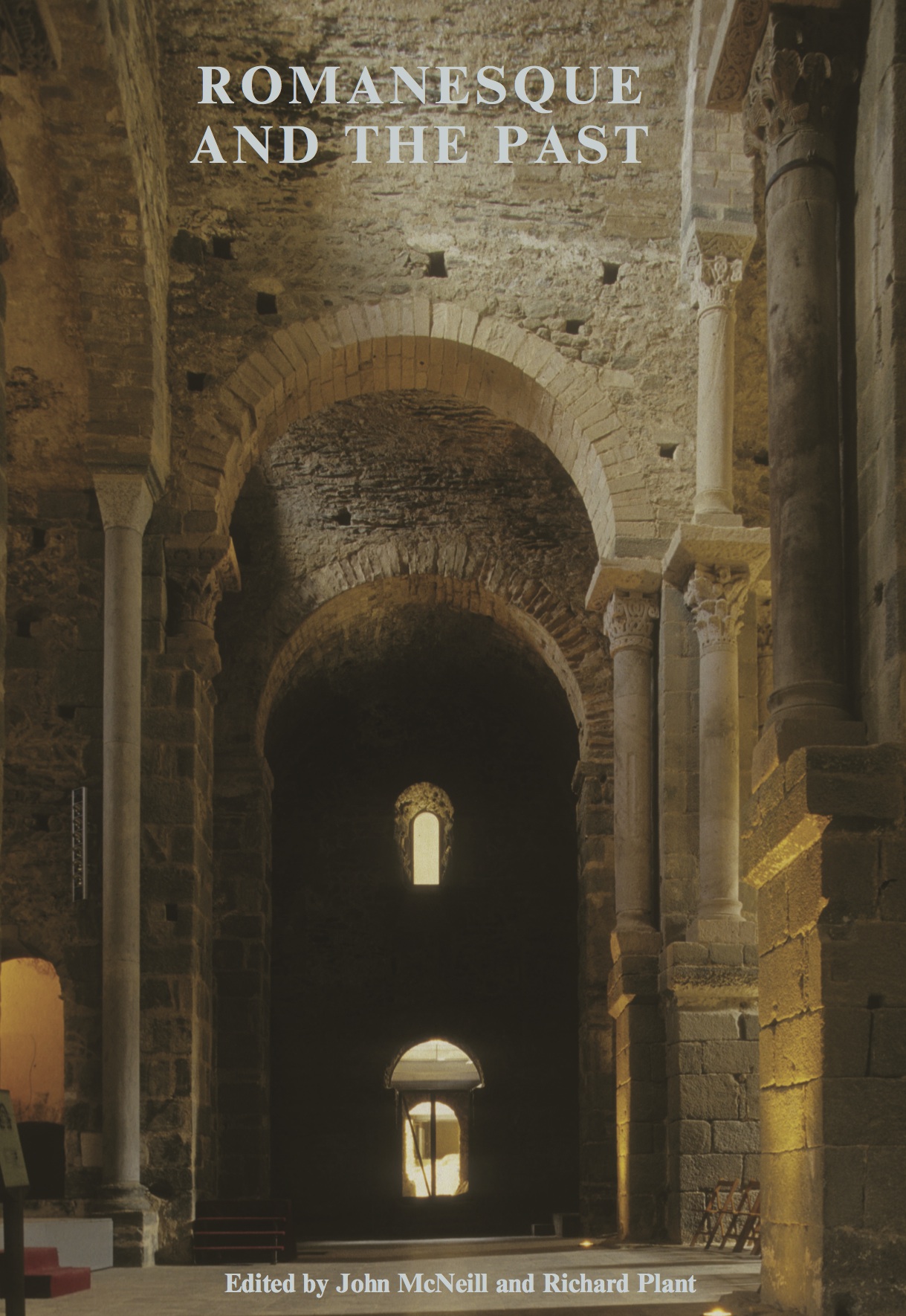
The nineteen papers collected in this volume explore a notable phenomenon, that of retrospection in the art and architecture of Romanesque Europe. They arise from a conference organised by the British Archaeological Association in 2010, and reflect its interest in how and why the past manifested itself in the visual culture of the 11th and 12th centuries. This took many forms, from the casual reuse of ancient material to a specific desire to re-present or emulate earlier objects and buildings. Central to it is a concern for the revival of Roman and early medieval forms, spolia, selective quotation, archaism and the construction of histories.
The individual essays cover a wide range of topics and media: the significance of consecration ceremonies in the creation of architectural memory, the rise of pictorial concepts in 12th-century chronicles, the creation of history in the Paris of Hugh of St-Victor, and the appeal of the works of Bernward of Hildesheim and of Hrabanus Maurus in the centuries after their deaths. There are studies of buildings and the ideological purpose behind them at Tarragona, Ripoll, Cluny, Pannonhalma (Hungary), La Roccelletta (Calabria), and Old St Peter’s, comparative studies of Trier, Villenauxe and Glastonbury, and of Bury St Edmunds, Rievaulx and Canterbury, and wide-ranging papers on the tantalising evidence for an engagement with an overseas past in Ireland, an Anglo-Saxon past in England, and a Milanese past among the aisleless cruciform churches of Augustinian Europe. The volume concludes with an assessment of the very concept of Romanesque.
Table of Contents
Chapter 1: Gerhard Lutz, Memorising Bernward of Hildesheim in the 12th Century: A Contribution to High Medieval Imitatio
Chapter 2: Lucy Donkin, Making an Impression: Consecration and the Creation of Architectural Memory
Chapter 3: Richard Gem, St Peter’s Basilica in Rome c. 1024–1159: A Model for Emulation?
Chapter 4: Kai Kappel, Architecture as a Visual Memento? La Roccelletta in Calabria
Chapter 5: Jill Franklin, Iconic Architecture and the Medieval Reformation: Ambrose of Milan, Peter Damian, Stephen Harding and the Aisleless Cruciform Church
Chapter 6: Claude Andrault-Schmitt, Archaism or Singularity: The Nave Clerestory in Romanesque Architecture between the Loire and Dordogne
Chapter 7: Neil Stratford, Cluny and the Past
Chapter 8: Manuel Castiñeiras, The Portal at Ripoll Revisited: An Honorary Arch for the Ancestors
Chapter 9: Elizabeth Valdez del Álamo, Tarragona: Lieu de mémoire
Chapter 10: Roger Stalley, On the Edge of the World: Hiberno-Romanesque and the Classical Tradition
Chapter 11: Béla Zsolt Szakács, The Reconstruction of Pannonhalma: Archaism in 13th-Century Hungary
Chapter 12: Deborah Kahn, Uses of the Past in English Romanesque Sculpture: Beyond the Antique
Chapter 13: Peter Fergusson, Three Romanesque Patrons and their Interest in History: Anselm of Bury, Ailred of Rievaulx, Wibert of Canterbury
Chapter 14: Stephan Albrecht, Artistic Strategies for Institutional Memory: Trier, Villenauxe, Glastonbury
Chapter 15: Beatrice Kitzinger, From Hrabanus Maurus to Regensburg: Romanesque Praise for the Holy Cross
Chapter 16: Andrea Worm, Visualising History: The Rise of Pictorial Concepts in Twelfth-Century Chronicles
Chapter 17: Conrad Rudolph, Time, Place and the Construction of History in Early Twelfth-Century Paris
Chapter 18: Eric Fernie, The Concept of the Romanesque