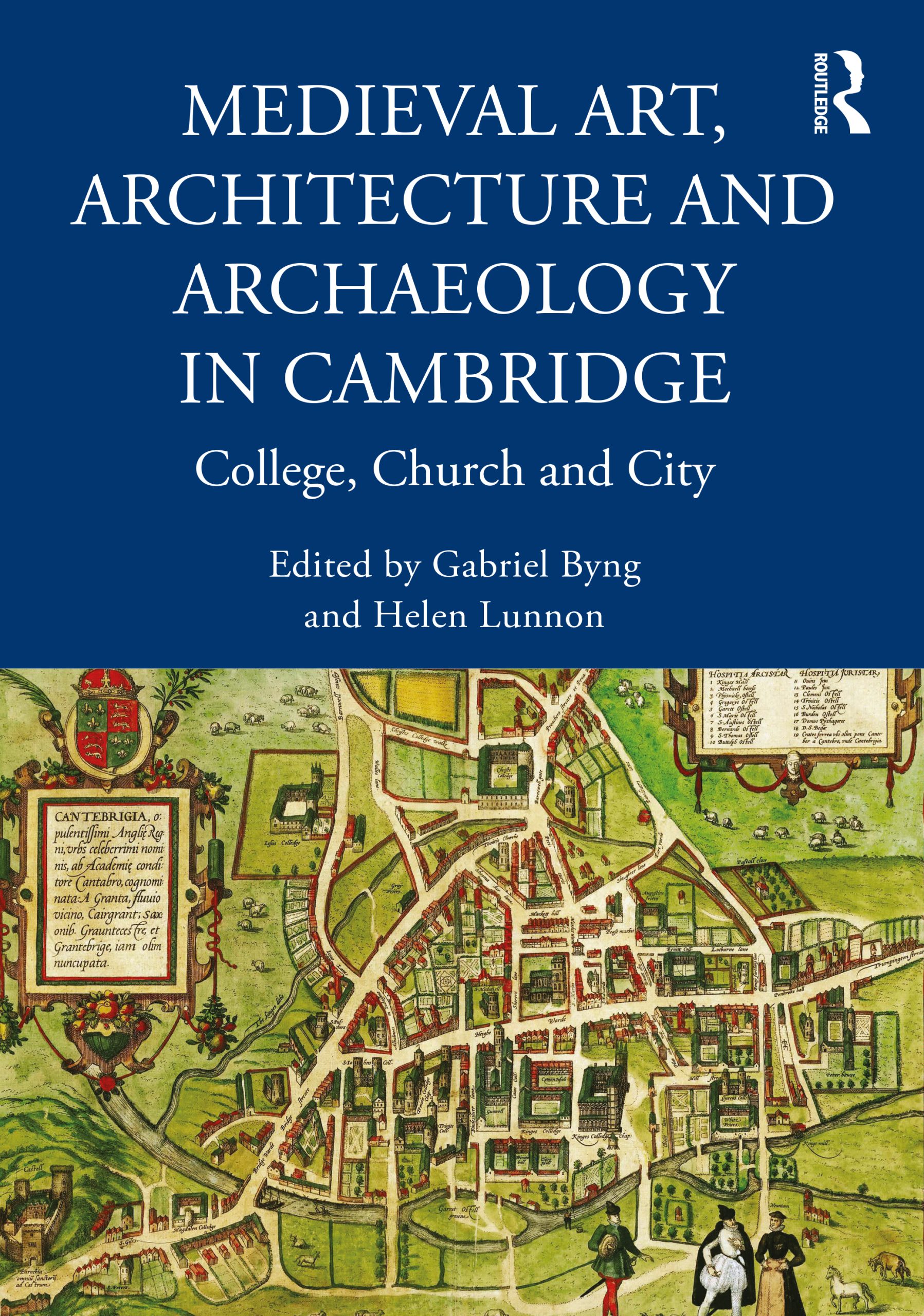
Medieval Art, Architecture and Archaeology in Cambridge explores the archaeology, art, and architecture of Cambridge in the Middle Ages, a city marked not only by its exceptional medieval university buildings but also by remarkable parish churches, monastic architecture, and surviving glass, books, and timber work.
The chapters in this volume cover a broad array of medieval, and later, buildings and objects in the city and its immediate surrounds, both from archaeological and thematic approaches. In addition, a number of chapters reflect on the legacy and influence medieval art and architecture had on the later city. Along with medieval colleges, chapels, and churches, buildings in villages outside the city are discussed and analysed. The volume also provides detailed studies of some of the most important master masons, glassmakers, and carpenters in the medieval city, as well as of patrons, building types, and institutional development. Both objects and makers, patrons, and users are represented by its contents. The volume sets the archaeological and art historical analysis in its socio-economic context; medieval Cambridge was a city located on major trade routes and with complex social and institutional differences.
In an academic field increasingly shaped by interdisciplinary interest in material culture, Medieval Art, Architecture and Archaeology in Cambridge marks a major new contribution to the field, focussing on the complexity, variety, and specificity of the buildings and objects that define our understanding of Cambridge as a medieval city.
Table of Contents
- Chapter 1: John S. Lee, Medieval Cambridge: Borough, Churches, and Colleges in Their Economic and Social Context
- Chapter 2: Paul Everson and David Stocker, A ‘Coffin’ for St Audrey: Some Misunderstandings about Middle-Saxon Cambridge?
- Chapter 3: Paul Everson and David Stocker, The Late-Saxon Graveyard at Cambridge Castle and the Origins of Urbanism in Cambridge
- Chapter 4: Cathrine E. Hundley, The People of Holy Sepulchre, Cambridge, in the 12th Century
- Chapter 5: Jill A. Franklin, Exploring the Changing Face of Architecture across the Long 12th Century: The Lost Anglo-Norman Churches of Augustinian Barnwell Priory and the Scattered Remains of Romanesque Cambridge
- Chapter 6: Meg Bernstein, The Parochial Nave in 12th- and 13th-Century Cambridgeshire
- Chapter 7: Paul Binski, Two Early Collegiate Parish Churches in Cambridge: St Michael’s and Little St Mary’s
- Chapter 8: Andrew Budge, Patrons, Social Networks, and the Architecture of Collegiate Churches in and around Cambridge in the Early 14th Century
- Chapter 9: Zachary Stewart, An Architecture of Incumbency? Burwell and Beyond
- Chapter 10: Frank Woodman, John Wastell: Architect, Genius, and All-Round Mr Fix-It
- Chapter 11: Lucy Wrapson, Thomas Loveday and His ‘Occupation of Carpynter’s Craft’
- Chapter 12: Anya Heilpern, ‘Souvent Me Souvient’: Remembering Lady Margaret Beaufort’s Painted Glass in Cambridge
- Chapter 13: Michael A. Michael, The Aesthetics of Change: Edward III’s Secretum Secretorum and English Manuscript Illumination of the 14th Century
- Chapter 14: Nicholas Rogers, Common Seals? The Iconography of the Medieval Seals of Cambridge Colleges
- Chapter 15: Alexandrina Buchanan, Robert Willis On Cambridge: Church, Colleges, and City
- Chapter 16: Spike Bucklow, Morris, Leach, Parr, and Gothic Mural Decoration in Victorian Cambridge
- Chapter 17: Arnold William Klukas, Oxbridge in America: Archaeology, Emulation, and Disneyfication
Site Reports
- Chapter 18: Eric Fernie, The Anglo-Saxon Church of the Holy Trinity at Great Paxton
- Chapter 19: John McNeill, St Bene’t, Cambridge
- Chapter 20: Peter Draper and Richard Halsey, Jesus College Chapel